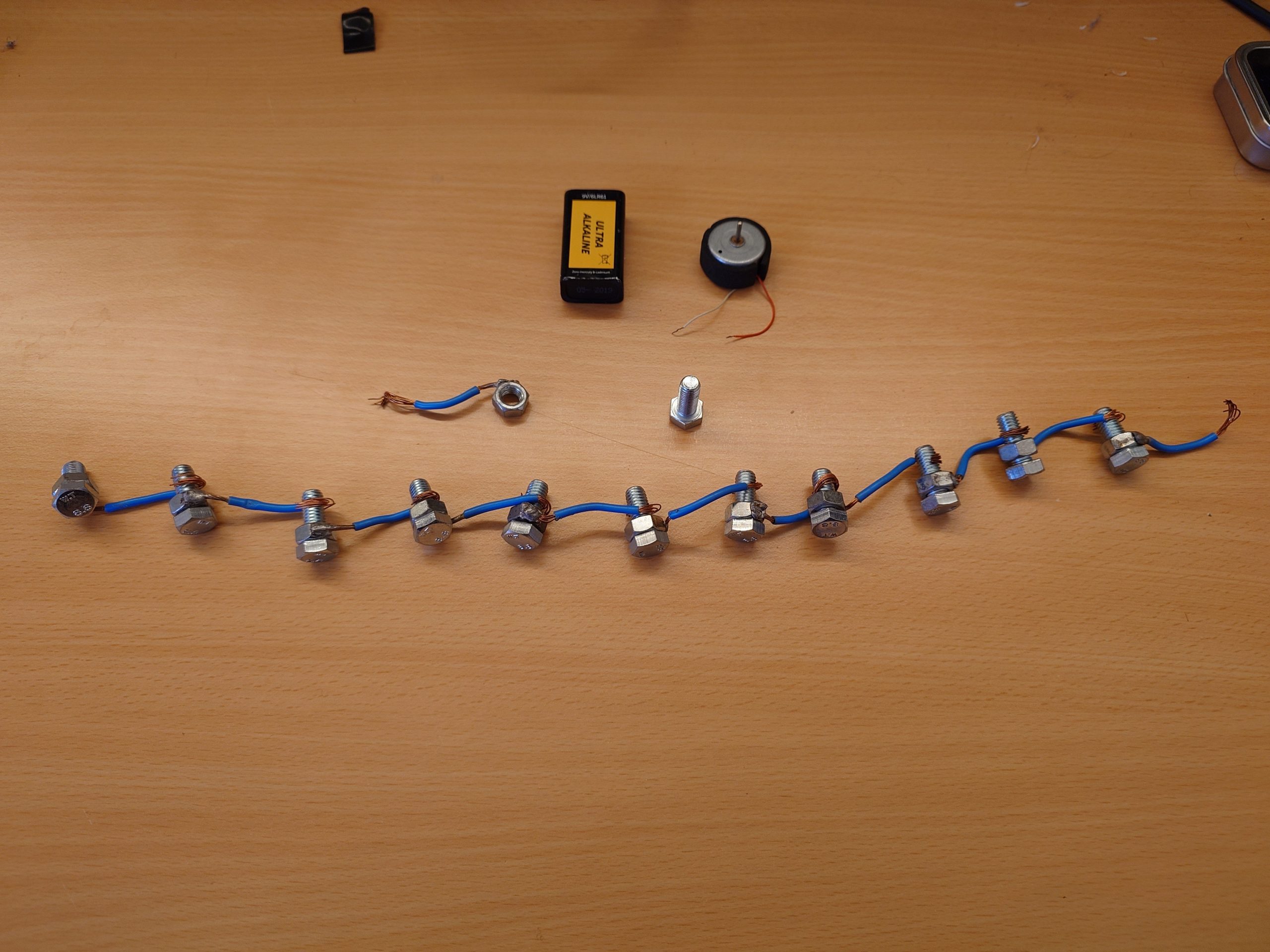
About a decade ago, I had an idea for proposing to my then girlfriend, now wife. I wanted to make a physical game box with keys that unlocked different effects. I got as far as a prototype of the key system, and the parts have stayed in my empire of dirt with the other bits and bobs ever since.
Screwing a bolt into place would bridge the intended electrical contacts and complete a circuit. I liked that the action itself could be part of the puzzle: find the right place, turn the bolt, and something happens.
The keys were bolts. The locks were nuts with wires attached.
The circuit idea
The prototype used a 9 V supply. Several contact points connected in series can make the output depend on all of them being closed. Electrically, that gives an AND condition. The circuit can tell whether the path is complete; it has no memory of the order in which the bolts were inserted.
All keys present, or keys in order?
That distinction matters for the game. If the puzzle only requires several keys to be present, series contacts are enough. A puzzle that requires a particular sequence would need a mechanical way to enforce that sequence or some additional state, such as a small controller. I would decide which behaviour the game needs before adding parts.
What I would check before putting it in a box
The contact is the part I would spend time testing. A loose bolt can appear to be in place while making an intermittent connection. I would check continuity with a meter while turning and moving it, then repeat the test after mounting it in the material intended for the box. The wires also need strain relief so the player’s turning action does not pull on a solder joint.
I would keep exposed metal contacts on a low-voltage battery circuit and insulate nearby conductors to prevent accidental shorts. If an effect needs more current than the contacts can reliably switch, I would use the contacts as an input to a suitable driver. The load determines the driver and protection needed; this photo is a prototype idea rather than a complete wiring guide.
The next version could start with a single indicator and a few keys. Once that works repeatedly, I could connect the actual effect and see whether the puzzle is still enjoyable to use. A simple circuit leaves more time for the physical details: where the keys are hidden, how they feel and what the player discovers.
I have kept the parts because I still like the idea. It is a small, tangible way to make a box react to someone opening it, and I would like to finish it eventually.
Leave a Reply